American Weapons Memories
Two independent sources, or it doesn’t go in the episode.
Weapons of the American frontier, and the people who actually carried them. Every claim rests on something checkable — a military record, a published historian, oral history from descendants, a catalogued museum piece. When we get it wrong, we correct it in public.
- Episodes published
- 23
- Subscribers
- 3,300
- New episodes
- Every 2 days
Featured episode
Latest episode
New episodes every week. Subscribe and you’ll know when.
 28:47
28:47 25 “Illegal” Weapons WWII GIs Built From Scrap
Watch on YouTube (opens in a new tab)The Book
The video gives you the hook. This book gives you the proof — names, dates, and where it’s written down.
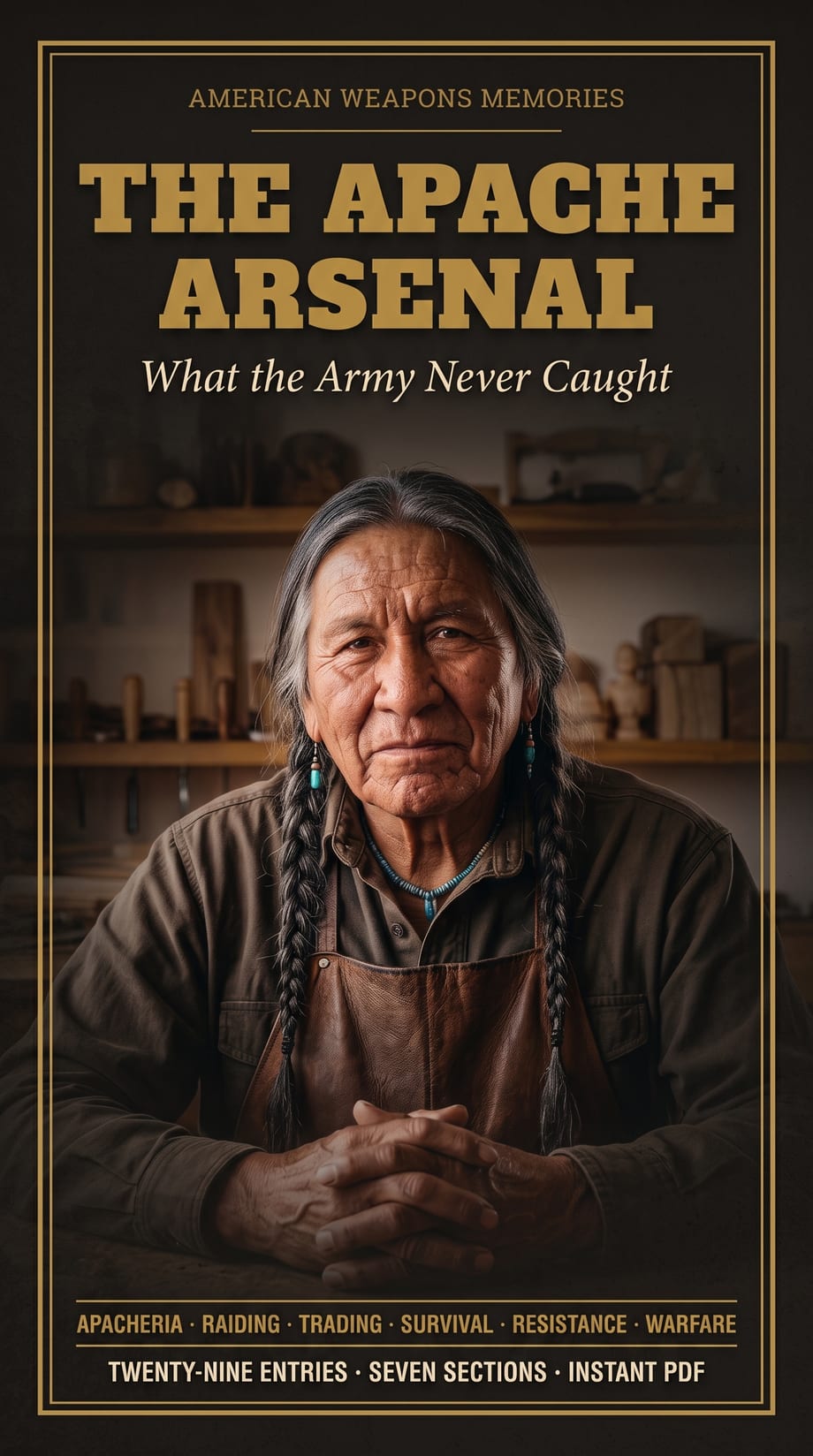
The Apache Arsenal
A video cannot carry the second source, the disagreement between two historians, or the full life of the person who carried the weapon. The book can. Twenty-nine entries, one campaign, each one built the same way: who carried it, the record, and what became of it.
Every claim rests on something checkable — a military record, a published historian’s work, oral history recorded directly from descendants, a catalogued museum piece. Where two respected sources disagree, the book shows both instead of quietly picking the cleaner story. We even show you the four places we got it wrong ourselves during production, and how we fixed it.
Get the Book
Launch price
$15 Regular price $19
29 entries across 7 sections, 60 pages, with the sources cited entry by entry. Instant PDF download.
Get the book — $15 (opens Gumroad in a new tab)Launch price — limited time only
Buy it once. Any future correction or revision to this book is free.
Checkout happens on Gumroad, which opens in a new tab. This page stays open behind it.
The Apache Arsenal
What’s Inside
The Eight-Part Mold
Every entry follows the same structure, so you always know where to look for what.
- What They Called It
- Who Carried It, and Why
- The Details
- Why It Was Built This Way
- What the Records Show
- Why It Disappeared
- A Note on Provenance and Respect
- Where to See It Today
Sections and Entries
29 entries, grouped into 7 sections.
| Section | Entries |
|---|---|
| I. Built Without a Factory | 5 |
| II. What the Army Never Saw | 3 |
| III. Named Ground | 3 |
| IV. The Ones Who Got Away | 2 |
| Portraits | 13 |
| The End of the Free War | 2 |
| One Last Entry | 1 |
| Total | 29 |
The Portraits section alone holds thirteen full biographies — as many as the book’s first four chapters combined.
Click here to see the full bibliography and how a claim gets verified.
The book closes with an annotated bibliography — every source cited across the 29 entries, in one place, each with a line on what it contributed. 33 sources in total, drawn from:
- U.S. Army campaign records
- Published academic ethnohistory
- Catalogued museum collections
- Battlefield archaeology
- Oral history recorded by Apache communities themselves
It also carries a page stating the standard plainly, so you can check the book against it instead of taking its word:
- Two sources, minimum
- Every factual claim rests on at least two independent sources. Where only one credible source could be found, the book says so rather than treating a single account as settled fact.
- Honesty notes, not silence
- When sources disagree on a date, a number, or a detail of how someone died, the book reports the disagreement instead of quietly choosing the more dramatic version.
- What was left out
- Roughly half of the entries originally planned did not survive this process. Anything without a documented, dated case attached to it was cut rather than padded out.
- No appraisals
- The book never estimates the market value of a historical object. It points to what to verify, and where.
About the channel
What this channel is
American Weapons Memories is a history channel about the weapons of the American frontier and the people who actually carried them — Apache warriors, Comanche raiders, Appalachian farmers, GIs improvising in the field. Not the famous rifles in a museum case. The improvised ones, the salvaged ones, the ones built out of whatever was at hand.
Every episode takes one theme and works through it object by object: what it was, who made it, what it was made from, and what the written record actually says about it. Roughly half an hour, one subject, no filler. New episodes every week.
The thread running through all of it is ingenuity under pressure — people with no factory, no supply line and no time, solving problems that armies with all three could not solve back. That is the story we keep finding, and it is the reason the sourcing matters: it is a good enough story that nobody needs to embellish it.

How we check it
Two independent sources, minimum
No claim enters an episode on the strength of a single source. It takes at least two, independent of each other — a military record, a published historian’s work, oral history recorded directly from descendants, a catalogued museum piece. If there is only one, or if the sources contradict each other, we say so out loud instead of picking the version that tells better.
That sounds obvious. On this subject it isn’t: a great deal of what circulates about the American frontier traces back to a single account, repeated for a century without anyone checking it again.
And when we get it wrong, we correct it
A standard that never costs you anything isn’t a standard. The proof that this one works is the four times it forced us to go back during production — Cochise, Geronimo, Massai and Skeleton Canyon — each one caught by outside review, each one corrected with the source that forced the change shown alongside it.
The corrections stay. We don’t erase the error — we show it next to the corrected version, in the book and on the channel.
Corrections on the record
Four entries were corrected during production, each one flagged by outside review before the book went out. They are listed in the order the manuscript recorded them.
-
Cochise
A sourcing error in the Cochise entry, flagged by external review and corrected before publication.
Manuscript v8 · August 27, 2026
-
Geronimo
A sourcing error in the Geronimo entry, rewritten rather than quietly amended, with the source that forced the change shown alongside it.
Manuscript v9 · August 27, 2026
-
Massai
A sourcing error in the Massai entry, caught by external review after the Portraits section was expanded.
Manuscript v11 · August 27, 2026
-
Skeleton Canyon
Not an error of fact but of confidence: an unsupported superlative claim, softened to what the record actually supports.
Manuscript v13 · August 27, 2026
Archive
Every episode
23 episodes, newest first. Each one opens on YouTube.
-
 28:05
28:05 25 "Strange" Comanche Weapons That Made Them the Most Feared Riders on the Plains
-
 28:28
28:28 25 Apache "Weapons" That Forced Warriors to Fight Differently
-
 27:52
27:52 25 "Weapons" Apache Warriors Improvised When Every Supply Route Into Their Territory Was Cut Off
-
 28:18
28:18 25 “Primitive” Appalachian Weapons That Make Modern Tactical Gear Look Ridiculous
-
 28:54
28:54 25 “Illegal” Apache Tricks That Made Them Almost Impossible to Catch
-
 27:31
27:31 25 “Poor Man” Home-Defense Weapons That Made $5,000 Security Systems Look Useless
-
 28:59
28:59 25 "Illegal" Weapons Apache Warriors Built From Scrap to Outsmart the U.S. Army
-
 28:37
28:37 25 “Deadliest” Comanche Weapons That Made Them the Most Feared Riders on the Plains
-
 29:44
29:44 25 "Secret" WWII Weapons Families Found in Veterans' Attics After They Passed
-
 28:59
28:59 25 Apache "Weapons" That Outsmarted the U.S. Army for 20 Years
-
 27:45
27:45 25 “Poor Man” Weapons Our Grandfathers Built From Scrap That Made Expensive Guns Look Useless
-
 18:58
18:58 15 Forgotten Combat Knives Hiding in American Attics That Are Felonies Today
-
 26:05
26:05 25 "Banned" Weapons Every WWII Soldier Carried That Would Get You Arrested Today
-
 25:35
25:35 25 Illegal Weapons Korean War Veterans Smuggled Home and Never Spoke of Again
-
 27:09
27:09 25 "Forbidden" Weapons the U.S. Army Taught Every Soldier to Build and Then Made Illegal
-
 28:50
28:50 25 “Illegal” Weapons American GIs Built From Scrap During WWII
-
 29:06
29:06 25 Weapons WWII Veterans Hid in the Attic That Are Illegal to Own Today
-
 29:55
29:55 25 Illegal Weapons Vietnam Veterans Smuggled Home and Took to Their Graves
-
 29:46
29:46 25 Secret Weapons WWII Veterans Hid From Their Own Families Until the Day They Died
-
 32:29
32:29 25 Lost Weapons WWII Veterans Brought Home and Kept Quiet for 50 Years
-
 13:21
13:21 10 "Forbidden" Defense Tools Every Coal Miner Smuggled Past the Company Guards
-
 12:12
12:12 10 Farm Weapons That Were Normal in 1934 (And Are Felonies Today)
Newsletter
One email per episode. Nothing else.
When a new episode goes up you get a note — and with it one detail that didn’t make it into the video. Usually the one that’s hardest to tell on camera.